Google’s latest AI Mode update gives SME marketers a useful warning: search briefs that start and end with a keyword list are going to miss how people now ask for help.
On 19 May 2026, Google said AI Mode had surpassed a billion monthly active users globally. In the same update, Google said AI Mode queries had more than doubled every quarter since launch and that the average AI Mode search is three times the length of a traditional Search query. The pattern is clear enough for content planning: people are using search more like a planning assistant, comparison tool and question-answering system.
Every SEO brief now needs to describe the job the reader is trying to complete, as well as the phrase the page hopes to rank for.
Kahunam has already covered the mechanics of Google’s query fan-out in AI Mode and why it matters for traffic. The planning layer is different: a practical SME SEO brief should account for users asking longer, more specific questions.
Source: Google’s AI Mode usage update. Related Kahunam reading: Is Google’s Query Fan-Out in AI Mode Killing Your Website Traffic?
What changes in the brief
A traditional SEO brief often starts with:
- primary keyword
- secondary keywords
- target word count
- headings copied from ranking pages
- internal links
- meta title and description
Those fields still help. They are just not enough on their own.
AI Mode encourages longer queries, voice and image inputs, and searches framed around planning or decision-making. That means a brief should also define the task behind the query. A user might not search for “accountant Manchester”. They might ask which kind of accountant a limited company needs before hiring staff, what documents to prepare, and how to compare fees.
The page that answers only the short keyword can feel thin against that kind of search behaviour. The page that explains the decision path has a better chance of being useful, cited, remembered, or clicked when the user needs detail.
Replace keyword-only briefs with task briefs
The first change is to add a task statement near the top of every brief.
Instead of:
Primary keyword: local accountant for small business
Use:
Reader task: understand what type of accountant a UK small business needs, what questions to ask before choosing one, and what information to prepare before an initial call.
This forces the writer to think about the reader’s situation. It also gives editors a stronger test than keyword inclusion. If a section does not help the reader complete that task, it probably belongs elsewhere.
A good task statement should include:
- the reader’s starting point
- the decision or action they are trying to take
- the constraints that matter, such as budget, location, time, compliance or risk
- the point where the article should stop
That last point matters. AI-era SEO does not reward dumping every related subtopic into one page. A brief needs boundaries so the article stays focused.
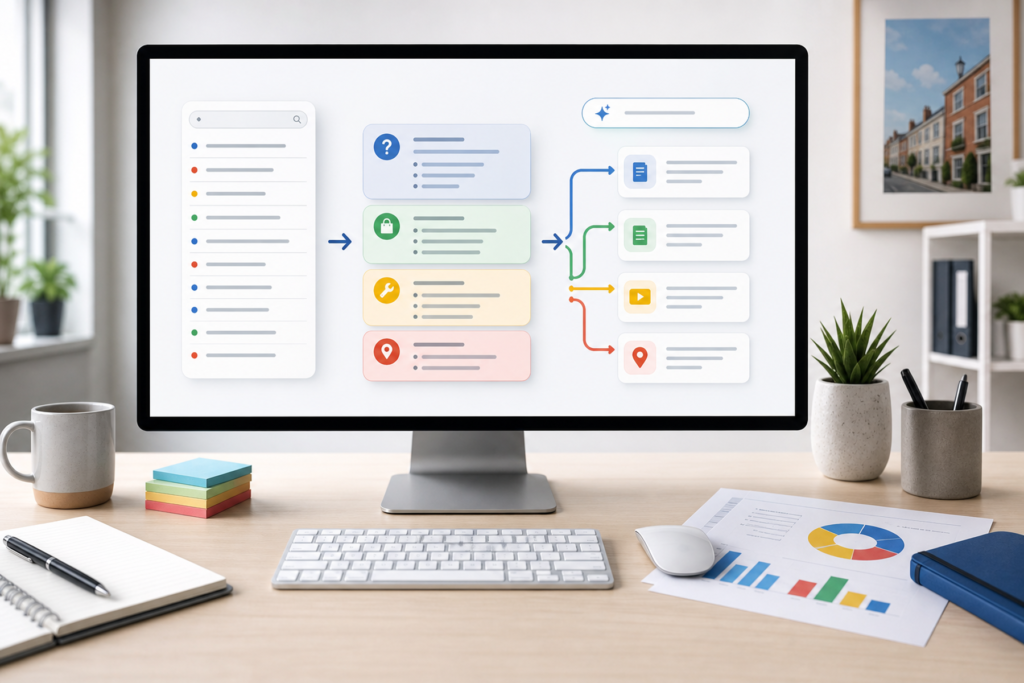
Add question clusters alongside keyword variants
Keyword variants still have a place, especially for title tags, headings and search demand checks. The brief should also add question clusters that mirror how a person explores the topic.
For an SME software comparison page, the clusters might be:
- fit: who is this software for, and who should avoid it?
- cost: what does it cost now and after growth?
- setup: what information, integrations or staff time are needed?
- risk: what can go wrong during migration?
- proof: what should a buyer check before committing?
These clusters give the writer a structure that can answer longer questions without turning the article into a loose FAQ. They also make it easier to spot missing sections during editing.
Question clusters should come from real research where possible: Search Console queries, customer support questions, sales call notes, internal site search, People Also Ask, and competitor pages. The brief writer should label the source of each cluster. A guessed question can be useful, but it should not look like evidence.
Brief for decisions, not just definitions
Many SME searches are not purely informational. The reader is usually trying to choose, prioritise, diagnose, budget or plan.
That should change the required sections in the brief. A definition article can explain what something is. A decision-support article should help the reader compare options and avoid common mistakes.
Useful additions include:
- a short “when this matters” section
- a comparison table with practical criteria
- warning signs or limitations
- a checklist the reader can use before acting
- examples for different business sizes or levels of maturity
The aim is to make each section earn its place. If the target reader only needs a quick definition, keep it short. If the reader is making a decision with cost or risk attached, the brief should ask for evidence, trade-offs and next steps the reader can take themselves.
Make source requirements explicit
AI search features raise the cost of vague content. A brief should state which claims need sources before the writer starts.
For SMEs, the most important source rules are simple:
- product, platform or policy claims should link to the original source
- legal, tax, health and finance claims need extra care and should avoid overstatement
- statistics should include the date, geography and method where available
- claims about Google’s systems should use Google sources where possible
This makes the editor’s job easier. It also protects the article from sounding more certain than the evidence allows.
In this topic, for example, it is fair to say Google reported a billion monthly active users for AI Mode and longer average AI Mode queries in May 2026. It would not be fair to promise that a specific brief format will win AI Mode visibility. Google has not given that kind of guarantee, and SME content should not imply one.
Add an “AI answer usefulness” check
Before a brief is approved, add one practical editorial question:
If an AI answer used this page as a source, which sentence, table or example would be worth quoting?
This check helps make the page specific enough to be useful. Generic introductions, recycled definitions and unsupported advice are weak for humans too.
Look for assets that carry real value:
- a clear framework
- a worked example
- a checklist based on actual constraints
- a comparison that helps the reader choose
- a concise explanation of a confusing term
If the brief does not ask for at least one of those assets, the finished article may be easy to summarise but hard to trust.
A simple SME SEO brief template
Use this structure as a starting point:
- Reader task: what the reader is trying to decide, understand or do.
- Primary search theme: the main phrase or topic.
- Audience: business type, role, knowledge level and location if relevant.
- Question clusters: grouped questions with sources.
- Required evidence: primary sources, internal data, examples or screenshots.
- Decision support: comparison, checklist, criteria or warnings.
- Internal link: the related Kahunam or site article that continues the learning path.
- Exclusions: what the article should not cover.
- Success test: what the reader should be able to do after reading.
This is still an SEO brief. It still needs search demand, title planning, metadata and internal links. The difference is that those elements support the reader task instead of replacing it.
The practical takeaway
Google’s AI Mode data points to a search environment where people ask longer questions and expect help with decisions, not just definitions. SME SEO briefs should catch up.
Start each brief with the task behind the query. Group questions by the reader’s decision path. Require sources for claims that matter. Ask for one genuinely useful asset, such as a checklist, example or comparison.
That gives writers clearer direction and gives readers a page that helps them move from question to action.
Author