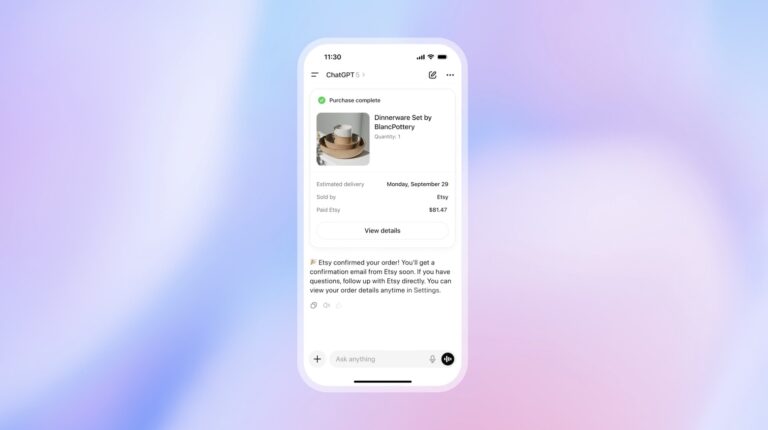

AI assistants are now part of product discovery. ChatGPT can show product options with images, prices, reviews, and merchant links. Perplexity can take some users from research to checkout inside its answer interface. If you run a Shopify store, the practical question is simple: can these tools read your product data, trust it, and send shoppers to the right place?
What has changed
Two major AI platforms now offer shopping experiences:
ChatGPT lets users describe what they are looking for, answer clarifying questions, and compare product options in conversation. OpenAI says ChatGPT may use product metadata from third-party providers or directly from merchants, and that Shopify product data is already integrated through Shopify Catalog.
Perplexity takes a more transactional route for supported merchants. Users can search conversationally, compare product cards, and, in some cases, buy through Instant Buy powered by PayPal. PayPal says retailers remain the merchant of record, which means the merchant still owns fulfilment, returns, and the customer relationship.
Both platforms are trying to sit between “I need something” and “I will buy this”. For Shopify merchants, that creates a new discovery layer to monitor alongside Google, paid social, marketplaces, and email.
How ChatGPT shopping works
When someone asks ChatGPT for product help, the experience can look like this:
- User describes their need, such as “I need running shoes for flat feet under £150”.
- ChatGPT asks follow-up questions about budget, brand preference, terrain, or cushioning.
- The system searches product information from the web, third-party providers, and merchant data sources.
- Results appear as product cards with images, prices, reviews, and merchant links.
- User clicks through to a merchant’s website, or uses checkout where that is supported.
For many Shopify stores, the important point is still product data quality. ChatGPT needs clear titles, descriptions, images, prices, availability, variants, reviews, and structured product information before it can confidently recommend an item.
OpenAI’s Product Feed Specification shows how merchants can share structured product data for ChatGPT shopping and commerce experiences. Shopify merchants should also keep an eye on Shopify Catalog and Instant Checkout support, because the exact merchant route may differ by market and eligibility.
How Perplexity shopping works
Perplexity differs in one crucial way: checkout can happen inside the answer interface for supported purchases.
- User searches conversationally, such as “best wireless earbuds for running”.
- Perplexity shows product options tailored to the query.
- User compares products in the interface.
- For eligible purchases, Instant Buy lets the user pay without leaving Perplexity.
- PayPal handles the payment layer.
PayPal’s launch note says merchants remain the merchant of record. In plain terms, you still handle fulfilment, returns, and customer service. Perplexity and PayPal handle the transaction layer, but the order relationship remains with the retailer.
Availability is still narrower than normal web search. Treat Perplexity shopping as an emerging channel, not as a replacement for your existing Shopify acquisition work.
What it means for Shopify stores
These platforms create a different customer journey. Instead of:
Google search -> click result -> browse site -> maybe buy
It can become:
Ask AI -> compare recommendations -> click to site or checkout -> buy
A visitor who lands on your product page via ChatGPT may already have compared options and narrowed their requirements. That can mean more qualified traffic, but it also means less control over how the shortlist was created.
Early AI-search referral data suggests some visitors spend longer on site and view more pages, but conversion impact still varies by store, category, and query type. For more detail, read Do People Actually Buy Through AI Search? What the Research Shows.
Improving your chances of appearing
Unlike Google Shopping, there is no simple dashboard where every Shopify merchant can upload a feed, set bids, and control placement across these AI assistants.
For ChatGPT:
- Products can be discovered from web crawling, third-party metadata, Shopify Catalog, and merchant-provided product feeds.
- Clear product pages, accurate structured data, and complete catalogue information make products easier to understand.
- OpenAI says merchant ranking can consider availability, price, quality, and whether the merchant is the maker or primary seller.
- Placement is not the same as paid search bidding, so traditional paid shopping tactics do not map cleanly.
For Perplexity:
- Instant Buy depends on eligible merchants and payment integration.
- Standard product pages can still appear as recommendations when Perplexity can read and trust the information.
- Larger retailers may need a direct merchant or payment route before checkout is available inside the interface.
You cannot directly force either platform to recommend your products. You can improve the inputs: accurate product titles, useful descriptions, current prices, clear images, availability data, reviews, returns information, and crawlable product pages.
For a more detailed setup checklist, read How to Get Your Products into ChatGPT and Perplexity Shopping.
How to track AI shopping traffic
ChatGPT referral traffic can show up in Google Analytics 4. Look for:
- Referral source: chatgpt.com, chat.openai.com, or similar.
- Landing pages: which products are people arriving at?
- Behaviour: how do these visitors compare with organic search, paid search, and email?
Set up a custom segment to isolate AI referral traffic and track it separately.
Perplexity in-app purchases are harder to attribute. If someone buys through the app, you may see the order in Shopify without seeing the full browsing journey in your analytics. That attribution gap is part of the channel.
Monitor what you can: referral traffic, branded search trends, product-page engagement, assisted conversions, and overall conversion patterns. If AI shopping grows, the signal should appear across several reports rather than one perfect source.
What to do now
AI shopping matters, but it is not yet the centre of most Shopify acquisition plans. Google still processes far more shopping-intent searches, and paid media, email, organic search, and marketplaces still carry most ecommerce demand.
Useful next steps:
- Check whether you are getting visitors from AI sources and how those visitors behave.
- Make product data complete: titles, descriptions, prices, variants, images, reviews, availability, and returns information.
- Keep product pages crawlable and avoid blocking legitimate bots without understanding the trade-off.
- Watch Shopify Catalog, OpenAI merchant feed, and PayPal/Perplexity merchant routes for changes that affect your market.
Avoid three overreactions:
- Paying for vague “AI optimisation” packages that cannot explain what they change.
- Abandoning SEO or paid ads for a channel that is still developing.
- Ignoring AI shopping completely until competitors have already cleaned up their product data.
The practical takeaway
AI shopping changes where product discovery can start. Shoppers may compare products in ChatGPT or Perplexity before they ever reach your Shopify store.
Your best move is to make the store easier for machines and humans to understand: clean product data, accurate structured information, strong product pages, trustworthy reviews, clear pricing, and reliable fulfilment details. That work helps AI shopping visibility without weakening the channels you already depend on.
ChatGPT shopping and Perplexity Instant Buy features vary by market, merchant eligibility, and platform rollout. Check the current platform guidance before making technical or commercial decisions.
Author